For sportstats home page, and info in Test Cricket in Australia 1877-2002, click here
|
|
Z-score’s
Cricket Stats Blog The longest-running cricket stats blog on the Web
|
|
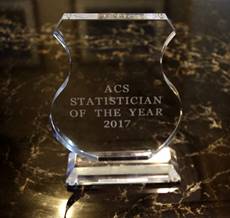
Charles Davis: Statistician
of the Year (Association of Cricket Statisticians and Historians)
|
|
BLOGARCHIVE 2025 |
||||||||||||||||||||||||||||||||||||||||||||||||||||||||||||||||||||||||||||||||||||||||||||||||||||||||||||||||||||||||||||||||||||||||||||||||||||||||||||||||||||||||||||||||||||||||||||||||||||||||||||||||||||||||||||||||||||||||||||||||||||||||||||||||||||||||||||||||||||||||||||||||||||||||||||||||||||||||||||||||||||||||||||||||||||||||||||||||||||||||||||||||||||||||||||||||||||||||||||||||||||||||||||||||||||||||||||||||||||||||||||||||||||||||||||||||||||||||||||||||||||||||||||||||||||||
|
At Perth,
England was over 100 runs ahead with nine second-innings wickets in hand. Yet
only two sessions later, England had lost the Test. How rare is this?... [Conditions:
team 2nd innings more than 100 runs ahead with nine or more wickets in hand.
Team is bowled out and loses match, all on the same day...] Adelaide
2006-07, after Flintoff's (in)famous declaration at 6/551, Australia 513,
England was 69/1 on final day. Out for 129, England lost by 6 wickets. Colombo 2009,
Pakistan was 285/1, 135 ahead on the last day. Out for 320 and lost by 7
wickets.
Subramanyaiah
Nallamutla Hanumantha Rao Srinivasulu
Nagabhushanam Hanumantha Rao Surampudi
Nethi Hanumantha Rao Sri Nagendra
Hanumantha Rao These four
names are all wrong and are completely made up. Ultimately, Indian umpiring
guru Ashru Mitra provided the full name. It is Sakaleshpur
Narayana Rao Hanumantha Rao “Rao” occurs
twice; it is not a typo. Narayana Rao is his father’s name. ******** Their first
scoring shot in Test cricket was a five… Shakeel Ahmed
Pak v Zim (2), Bulawayo (Queen's) 1994/95 PR Adams Cape
Town 1995-96 BW Hilfenhaus
Aus v SAf (1), Johannesburg (Wanderers) 2008/09 Naeem Islam
Ban v NZ (1), Chittagong 2008/09 MD Rae NZ v
WI Wellington 2025-26 ******** |
15 December 2025 Yet More Data on Fast Centuries Hundred in a
Session in the Fourth Innings of a Test SJ McCabe 189*
Aus v SAf (2), Johannesburg (Old Wanderers) 1935/36 A Melville 104*
SAf v Eng (1), Nottingham (Trent Bridge) 1947 NJ Astle 222 NZ
v Eng (1), Christchurch 2001/02 DR Smith 105* WI
v SAf (3), Cape Town 2003/04 Mushfiqur Rahim
101 Ban v Ind (1), Chittagong 2009/10 KS Williamson
121* NZ v SL (1), Christchurch (Hagley) 2022/23 TM Head 123 Aus
v Eng (1), Perth Stadium 2025/26 Prior to Head,
Williamson was the only one to do this for a winning side. Williamson remains
the only one to score a century after tea on the 5th day to win. Speaking of
Bulawayo, there is another feature of Wiaan Mulder’s 367 not out in July that
I have just noticed. He scored a century in a session twice in the one
innings. He scored 131 after tea on the first day and then 103 before lunch
next day. There are only three precedents: Mulder follows Bradman (334),
Hammond (336*) and Hayden (380). Rachin Ravindra
recently scored centuries in a session in two consecutive Tests, at Bulawayo
(once again, poor Zimbabwe!) and Christchurch. ******** Another Look at DRS LBW reviews. This time
including lbw decisions that did not attract a review. A block of 177
recent Tests was examined. In eleven of the Tests DRS was not used, so these
Tests were excluded. Only Top 6 batsmen were considered. Curiously, the
number of batsmen who ended up lbw in these Tests was actually 553. This
takes into account an additional 89 batsmen who were initially given not out
lbw, but the decision was overturned by a bowling review.
Sometimes
batsmen do not review an adverse decision because no reviews are available,
or they are simply in error and might well have been not out on review. This
appears to be quite uncommon, however. ******** |
||||||||||||||||||||||||||||||||||||||||||||||||||||||||||||||||||||||||||||||||||||||||||||||||||||||||||||||||||||||||||||||||||||||||||||||||||||||||||||||||||||||||||||||||||||||||||||||||||||||||||||||||||||||||||||||||||||||||||||||||||||||||||||||||||||||||||||||||||||||||||||||||||||||||||||||||||||||||||||||||||||||||||||||||||||||||||||||||||||||||||||||||||||||||||||||||||||||||||||||||||||||||||||||||||||||||||||||||||||||||||||||||||||||||||||||||||||||||||||||||||||||||||||||||||||||
|
In 1976
against New Zealand in Karachi, Majid Khan played one of the great opening
innings, reaching 108 runs before lunch on the first day. There is no full
scoresheet for this match, but now Afzad Ahmed has published a book that
includes a one-page linear score (produced by Ben Lawrence) of Majid’s
innings; as a result a full ball-by-ball record of the innings can be built. My rendering
of the innings can be found here. There are
still only six cases of a century before lunch on the first day. Majid’s
remains the fastest; he reached 100 off 77 balls. A feature of the play is
that only 18 eight-ball overs were bowled before lunch. Only 138 balls were
bowled before Majid reached his century. Even though it was almost 50 years
ago, the over rate is very similar to modern rates. ********
******** I was asked
about the unusual case of Indian captain Ajit Wadekar, who scored 44 and 0 in
two consecutive Tests in 1972-73. There are quite a lot of cases of players
making identical scores in two consecutive Tests if you include ducks,
although very few involving a score of 40 or more. Certainly the most notable
of all cases is Harbhajan Singh who scored 63 and 7 at Sydney in 2008, and
then the same at Adelaide. He did not play in the intervening Test in Perth. There are a
few players who batted eight times in four Tests without scoring a run,
although all include 0 not outs, including D Ramnarine and Chris Martin. ******** |
30 November 2025 More Data on Fast Centuries Travis Head’s
century at Perth (100 off 69 balls) has been described as one of the most
remarkable in Ashes, coming in the fourth team innings after none of the
previous three had reached 200. Measured from the start of the (team)
innings, Head’s innings was the second-fastest ever, behind a century by
David Warner in 2011-12. A list of the fastest centuries, measured in balls
bowled after the batsman came to the crease, follows… Fewest Balls
Bowled before a Batsman reached a Century
Well I suppose
this is much the same list as the fastest centuries in balls faced, but it
does add a bit of interesting data. The data is from various sources: no
balls may or may not be included. ******** Batsmen benefiting from DRS overturns.
Latham was given
out lbw twice (to Ebadot Hossain) in one over. ******** |
||||||||||||||||||||||||||||||||||||||||||||||||||||||||||||||||||||||||||||||||||||||||||||||||||||||||||||||||||||||||||||||||||||||||||||||||||||||||||||||||||||||||||||||||||||||||||||||||||||||||||||||||||||||||||||||||||||||||||||||||||||||||||||||||||||||||||||||||||||||||||||||||||||||||||||||||||||||||||||||||||||||||||||||||||||||||||||||||||||||||||||||||||||||||||||||||||||||||||||||||||||||||||||||||||||||||||||||||||||||||||||||||||||||||||||||||||||||||||||||||||||||||||||||||||||||
|
First-class
cricket at most different grounds
This table is
offered with uncertainties. The identification of grounds is sometimes
difficult especially with frequent changes of ground names. |
12 September 2025 Changing Face of Test Stats It has taken a
while, but I have updated the “hotscore” file, showing
the fastest-scoring players in Test history. The update shows the impact of
‘Bazball’, with no fewer than four current England players hurtling into the
all-time Top 20. Travis Head of Australia is another bat flying high. The Hot 100: The
Fastest-Scoring Test Batsmen of All Time Qualification:
2500 runs for recent careers. 1,500 runs for careers ending before year 2000. Batting
average greater than 20, batting position <7. Updated to September 2025.
If you relax the
qualifications quite a bit to include batsmen with just 500 runs and an
average over 15, and include tailenders, you also get an interesting list… The Fastest-Scoring
Test Batsmen (500+ runs) Qualification:
500 career runs. Batting average greater than 10. Updated September 2025.
L Amar Singh
(India 1930s) scored 292 runs at 102 runs/100 balls. The extended
lists are found here. At some point I will try to
update the other lists on that page, although there tends to be little
movement in the slow-scoring lists. (The previous
list
is here.) If you are
wondering about the fastest-scoring batsman of all, without qualification,
the Australian fast bowler Jhye Richardson has faced just 14 balls in Tests
and scored 18 runs, a scoring rate of 128 runs /100 balls. His last Test
appearance was in 2021, so he could conceivably play again. ******** There have also
been changes at the top in the area of head-to-head, batsman v bowler stats.
After Virat Kohli/Nathan Lyon just failed to take the top spot from
Smith/Broad last Australian season, Joe Root, facing Ravi Jadeja, swept in to
pass the 600 run mark. Here
is a short article I wrote on the subject for a magazine. ******** |
||||||||||||||||||||||||||||||||||||||||||||||||||||||||||||||||||||||||||||||||||||||||||||||||||||||||||||||||||||||||||||||||||||||||||||||||||||||||||||||||||||||||||||||||||||||||||||||||||||||||||||||||||||||||||||||||||||||||||||||||||||||||||||||||||||||||||||||||||||||||||||||||||||||||||||||||||||||||||||||||||||||||||||||||||||||||||||||||||||||||||||||||||||||||||||||||||||||||||||||||||||||||||||||||||||||||||||||||||||||||||||||||||||||||||||||||||||||||||||||||||||||||||||||||||||||
|
|
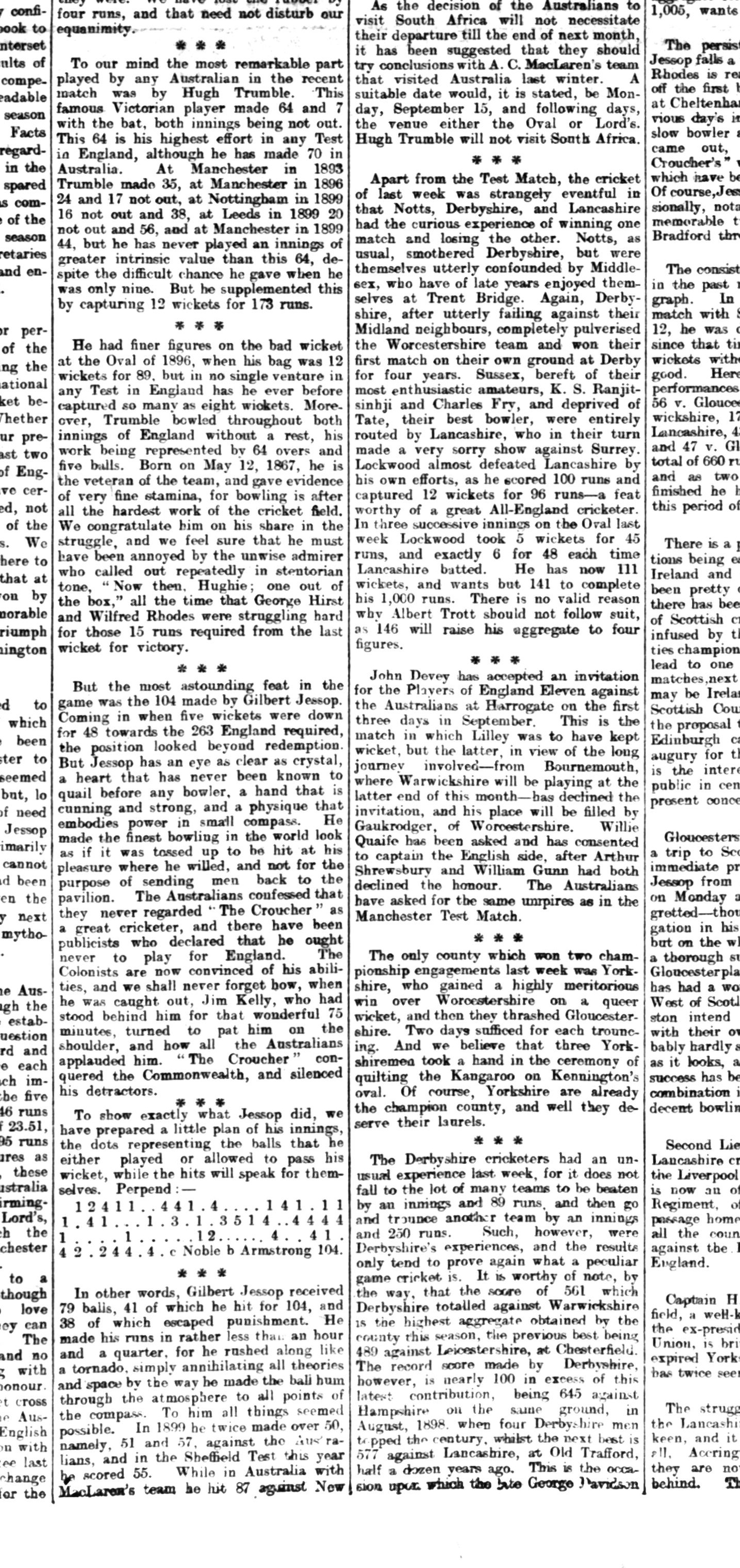
29 August 2025 1902 Revisited The 1902 England-Australia Tests still rank among
the finest and most memorable Ashes series. For the statistician, however, it
is a frustrating series in that it is poorly represented by original
scorebooks. At the Australian end, no tour book is known, and in England only
one full Test score (Edgbaston) survives, along with a partial score (lacking
bowling details) for the Manchester Test. Now there has been some progress, and on a couple of
fronts. Simon Wilde has published a fascinating book “Chasing Jessop”
about 1902 and focussing on Gilbert Jessop’s famed 104 at The Oval, where
England won by one wicket. Using the ever-expanding British Newspaper
Archive, Wilde has uncovered some new sources, a couple of which give
ball-by-ball accounts for Jessop’s hundred. Wilde found the source of Gerald
Brodribb’s account, a source that had eluded me for a long time. It was not
in a daily newspaper, but in The Athletic News and Cyclists’ Journal,
a weekly published five days after the event.
Test 1 Edgbaston: reconstructed ball-by-ball from a
full scorebook. Test 4 Old Trafford Aus 1st
innings reconstructed by me some years ago from newspaper reports and the
partial scorebook. Could do with more work. Test 5 The Oval: full reconstruction of England 2nd
innings by S Wilde. The cover page for the series, with the updated
files, is here. ******** |
||||||||||||||||||||||||||||||||||||||||||||||||||||||||||||||||||||||||||||||||||||||||||||||||||||||||||||||||||||||||||||||||||||||||||||||||||||||||||||||||||||||||||||||||||||||||||||||||||||||||||||||||||||||||||||||||||||||||||||||||||||||||||||||||||||||||||||||||||||||||||||||||||||||||||||||||||||||||||||||||||||||||||||||||||||||||||||||||||||||||||||||||||||||||||||||||||||||||||||||||||||||||||||||||||||||||||||||||||||||||||||||||||||||||||||||||||||||||||||||||||||||||||||||||||||||
|
A report in
the Adelaide
Chronicle
for the 5th day of the Adelaide Test in 1907-08 (15th
January) claimed that the temperature reached 111 degrees Fahrenheit (44
Celsius). I wondered about the accuracy of this, but the Adelaide Register
and the Advertiser both gave an official maximum for the city that day of
111.4 degrees “in the shade and 153 degrees in the sun”. The temperature at
Eucla in W.A. was recorded as 122 in the shade (50 Celsius) and “179 in the
sun” (!). John Benaud
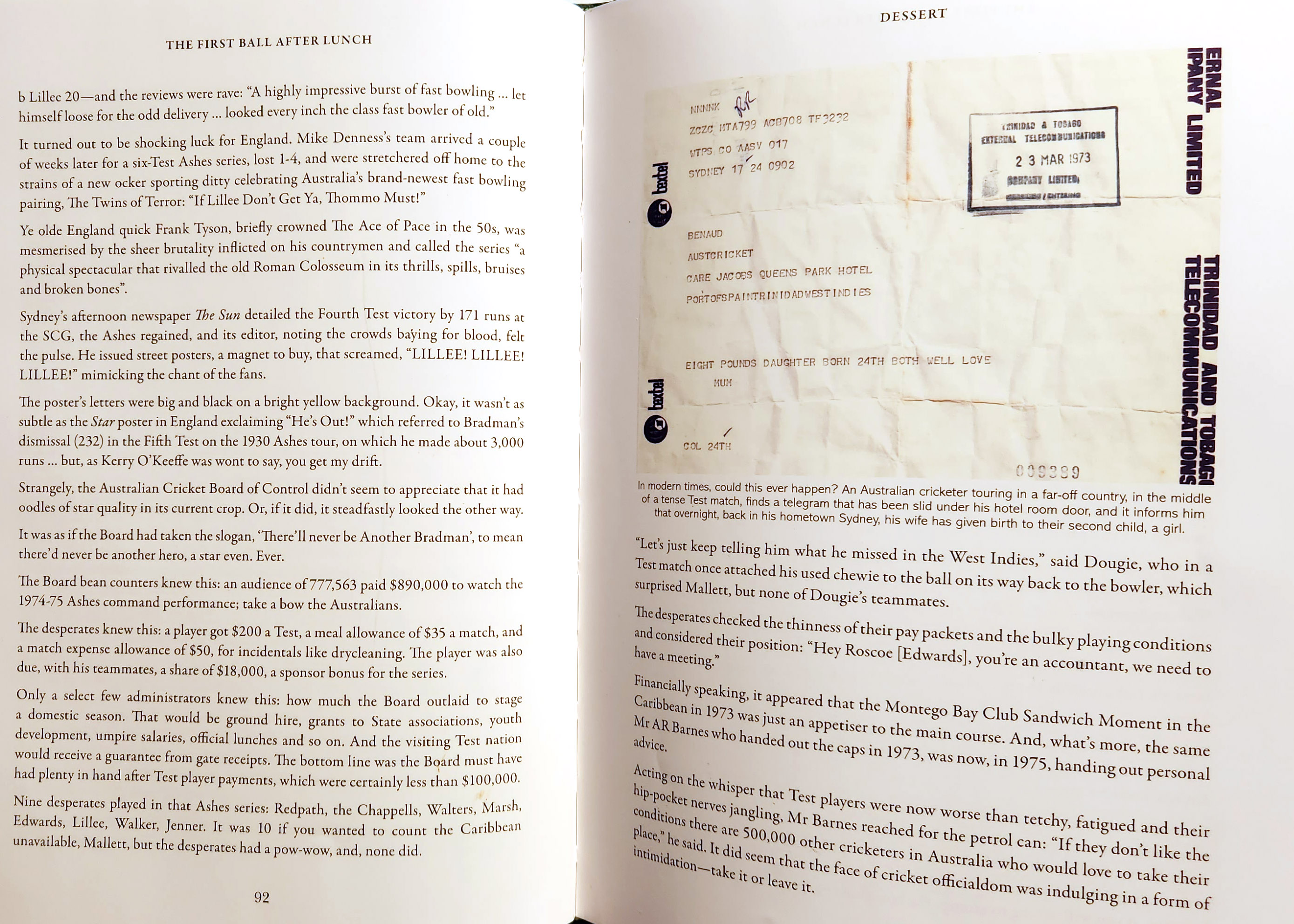
has a book out about the 1973 Australian tour of West Indies: “The First Ball after
Lunch”.
There are a couple of little snippets that show up how cricket, and society,
have changed. Benaud mentions player payments from the time: A$200 per Test
plus a few allowances. Sponsorship was starting to add to this, but not by a
lot.
I seem to
recall that one of Allan Border’s children was born while he was batting in a
Test. It was one of the only days of his career where he was dismissed twice. ******** |
Bob Simpson 1936-2025 I saw Bob
Simpson play from time to time in the late 60s/early70s. He played in Sydney
for Western Suburbs 1st Grade, whose home ground was near our home. Having
retired too early from first-class cricket, he was still one of the best bats
in the world, and he rather terrorised the Club bowlers. He was one of a
cohort of Australians at the time who gave up the game because of poor pay
and the need to make a career elsewhere. My father was a
1st grade umpire and knew Bob. One day when Wests were playing away and Dad
was umpiring I spent the day watching (getting out of Mum's hair). Bob gave
us a lift home. Dad introduced me. I was too shy to say anything much, but I
was most impressed that Dad and Bob were on a first name basis and chatted
all the way home. My school friend
Malcolm Gorham was a cricket (and Simpson) fanatic. While still at school, he
had managed to get a gig as Western Suburbs scorer, using linear scoring.
Malcolm went on to score Test matches at the SCG, but died (far too young)
decades ago. Simpson famously
returned to Tests in 1977 after a 10-year break and scored a couple more
centuries. Simpson’s
passing on August 15 brings to five the number of players from the 1966-67
tour of South Africa who have died in the last few months. I can't find any
other cases of five members of a team passing away so close to one another.
The nearest I found was five deaths in 639 days for the South African team
that played in Durban in Durban in 1935-36.
|
||||||||||||||||||||||||||||||||||||||||||||||||||||||||||||||||||||||||||||||||||||||||||||||||||||||||||||||||||||||||||||||||||||||||||||||||||||||||||||||||||||||||||||||||||||||||||||||||||||||||||||||||||||||||||||||||||||||||||||||||||||||||||||||||||||||||||||||||||||||||||||||||||||||||||||||||||||||||||||||||||||||||||||||||||||||||||||||||||||||||||||||||||||||||||||||||||||||||||||||||||||||||||||||||||||||||||||||||||||||||||||||||||||||||||||||||||||||||||||||||||||||||||||||||||||||
|
The
shortening of boundaries, which have been in place for more than 20 years
now, has led to shots for three becoming far less common. The most in this
decade is 45 at Brisbane in 2020-21. There were 85
threes in the Ashes Test at Adelaide Oval in 1994-95. Of the historical Top
20 where data is available, ten were at the MCG. At Headingly
in 2023, there were no threes at all. ******** A minor
record: Wiaan Mulder’s 367* at Bulawayo is the highest score by a batsman who
was dismissed by a no ball: previously Warner 335*. Mulder was 'bowled' by LT
Chivanga on 247. I believe
that Len Hutton was caught in the deep off a no ball when he made 364,
although in those days with the early call it was effectively a free hit. Most runs
added after being dismissed by a no ball: 279 by Sangakkara (287). Dale Steyn
'bowled' Sangakkara and had him dropped in the same over. The pair then added
more than 600 runs. |
14 August 2025 I thought I'd
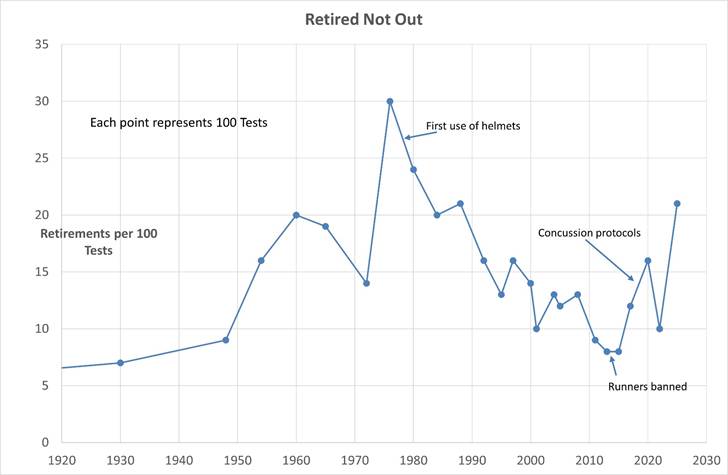
share an observation about the recent resurgence in batsmen retiring hurt.
The incidence of retirements has jumped in the last few years. I wouldn’t
read too much into each fluctuation in the figures, but there are definitely
some trends.
******** UPDATE of a list
from only a couple of weeks ago. At The Oval, for the second time in the
series, the losing side scored more runs off the bat than the winning side.
At Lord’s England had beaten India by 22 runs, at The Oval it was India
winning by 5 runs. There had only been four previous such Tests in all Test
history. Winning a Test with fewer runs off
the bat
Tests won by
runs margin with no follow-on. In the 1992
match, Sri Lanka managed to bowl 53 no balls to Australia’s 19, and lost by
16 runs. At the Oval, England bowled 22 wides to India’s 11 and lost by 5
runs. |
||||||||||||||||||||||||||||||||||||||||||||||||||||||||||||||||||||||||||||||||||||||||||||||||||||||||||||||||||||||||||||||||||||||||||||||||||||||||||||||||||||||||||||||||||||||||||||||||||||||||||||||||||||||||||||||||||||||||||||||||||||||||||||||||||||||||||||||||||||||||||||||||||||||||||||||||||||||||||||||||||||||||||||||||||||||||||||||||||||||||||||||||||||||||||||||||||||||||||||||||||||||||||||||||||||||||||||||||||||||||||||||||||||||||||||||||||||||||||||||||||||||||||||||||||||||
|
|
Forty years ago
(1985) I was travelling around southern Africa, part of a 5-month round the
world trip which also took me to North America and Europe. It was mostly low
budget solo travel - I never spent more than $20 on a night's accommodation,
even in Switzerland - but I did join small group tours to remoter places like
Namibia and Botswana. Since I wasn't
completely broke when I got home to Sydney, I drove up to Cairns and beyond
for a bit. Don't ask me why. After that I WAS completely broke. I have written
down a few little memories of that trip and my other travels last Century. https://www.sportstats.com.au/Travel/Travelslist.pdf ******** Making a Century
after being dropped first ball…
Since 2002 only.
The Hussey case is debatable and may not have been a dropped catch. |
||||||||||||||||||||||||||||||||||||||||||||||||||||||||||||||||||||||||||||||||||||||||||||||||||||||||||||||||||||||||||||||||||||||||||||||||||||||||||||||||||||||||||||||||||||||||||||||||||||||||||||||||||||||||||||||||||||||||||||||||||||||||||||||||||||||||||||||||||||||||||||||||||||||||||||||||||||||||||||||||||||||||||||||||||||||||||||||||||||||||||||||||||||||||||||||||||||||||||||||||||||||||||||||||||||||||||||||||||||||||||||||||||||||||||||||||||||||||||||||||||||||||||||||||||||||
|
Much has been
said about records set in the Kingston Test, with West Indies bowled out for
27. Some adds… The innings
saw the slowest over rate in Test history for a complete innings – around 55
balls per hour (pending a check of times). One could argue mitigating
circumstances. ******** In 1974
Gerald Brodribb published a biography of Gilbert Jessop (The Croucher) that
included a ball-by-ball summary of Jessop’s famous 104 in the Oval Test of
1902. Brodribb did not name his source, and over many years I have not been
able to locate it. Such frustration. ********* I try to
record fielder locations for all catches in Tests. In the Lord’s Test,
Washington c Brook v Archer was the first catch by a longstop that I have
noted since Tom Horan took a couple in 1879 ! I have often
thought that longstop would be a useful position in T20 with all those ramp
shots, but I haven't seen it in Tests. I don't know if anyone recalls
anything similar. ******** Most runs on
first day as a Test captain…
******** At Hyderabad
in 1983, Javed Miandad faced a hat-trick ball from BS Sandhu and went on to
score 280 not out in a partnership of 451 with Mudassar. Gavaskar
probably faced a hat-trick ball to start his 236 at Chennai but I don't have
enough detail to be sure. None of the reports I have specifically says so. I only have
ball-by-ball data for about 80-85% of hat-trick balls. If wickets are taken
with the last two balls of an over, then either bat could face the hat-trick
ball. ******** |
20 July 2025 I have written
before (as long ago as 2006!) about the intriguing limited-overs match in
South Africa in 1967 between the touring Australians and a “Sports Roundup
Invitation XI”, effectively a fully-representative South Africa. Although not
‘official’, it has enough hallmarks of a One-Day International to be
recognised as the first such match (IMHO).
South African XI v Australians,
50-over match, Johannesburg 4-Mar-1967
Australia Innings FoW
TR Veivers retired hurt at 5 for 276. South Africa Innings FoW
The match was 50
(6-ball) overs a side, with bowlers limited to 11 overs. Although arguably
played in a ‘picnic’ atmosphere, there was money at stake; it was taken
seriously enough for the keeper Brian Taber to be dropped and Simpson taking
the gloves to strengthen the Australians batting. Grahame Thomas of NSW was
in the team and scored 70; he had not played in the Tests, but his mere
presence in apartheid South Africa is interesting in that he was
part-aboriginal – especially in light of the D’Oliveira affair less than two
years later. For the South Africans, the first appearance of Barry Richards
is notable. Keith Stackpole
hit a ball from fast man Peter Pollock clean out of the ground, but was out
next ball. Tom Veivers then came in and appears to have retired hurt first
ball; he did not bowl later. The over eventually cost 10 runs even with two
wickets (Stackpole, Thomas) plus Veivers’ retirement (1 leg bye, 6, W, RH, 3,
W). The match was
scored by two women, “Miss P Williams and Miss SR Hall”. Tour scorer M
(Mitch?) McClennan is also named, but the score is not in his handwriting. (I
believe that McClennan was a South African scorer contracted to score on the
tour; he also did 1957-58). An image of a page from the score is
here.
I have posted before an article on the match by Alf Batchelor. ******** At Lord’s
England beat India by 22 runs in spite of hitting fewer runs off the bat.
There have only been five such Tests… Winning a Test with fewer runs off
the bat
Tests won by
runs margin with no follow-on. In the 1992
match, Sri Lanka managed to bowl 53 no balls to Australia’s 19, and lost by
16 runs. ******** |
||||||||||||||||||||||||||||||||||||||||||||||||||||||||||||||||||||||||||||||||||||||||||||||||||||||||||||||||||||||||||||||||||||||||||||||||||||||||||||||||||||||||||||||||||||||||||||||||||||||||||||||||||||||||||||||||||||||||||||||||||||||||||||||||||||||||||||||||||||||||||||||||||||||||||||||||||||||||||||||||||||||||||||||||||||||||||||||||||||||||||||||||||||||||||||||||||||||||||||||||||||||||||||||||||||||||||||||||||||||||||||||||||||||||||||||||||||||||||||||||||||||||||||||||||||||
|
250 and 150
in a first-class match. Dhruv Shorey,
252* and 150* Delhi v Assam 2022-23 Shubman Gill
269 and 161, Edgbaston 2025 Warwick
Armstrong came very close in 1920: 157* and 245 in a Sheffield Shield match ******** At Hyderabad
in 1983, Javed Miandad faced a hat-trick ball from BS Sandhu and went on to
score 280 not out in a partnership of 451 with Mudassar. Gavaskar
probably faced a hat-trick ball to start his 236 but I don't have enough
detail to be sure. None of the reports I have specifically says so. I only have
ball-by-ball data for about 80-85% of hat-trick balls. If wickets are taken
with the last two balls of an over, then either bat could face the hat-trick
ball. ****** |
11 July 2025 Here is a broad
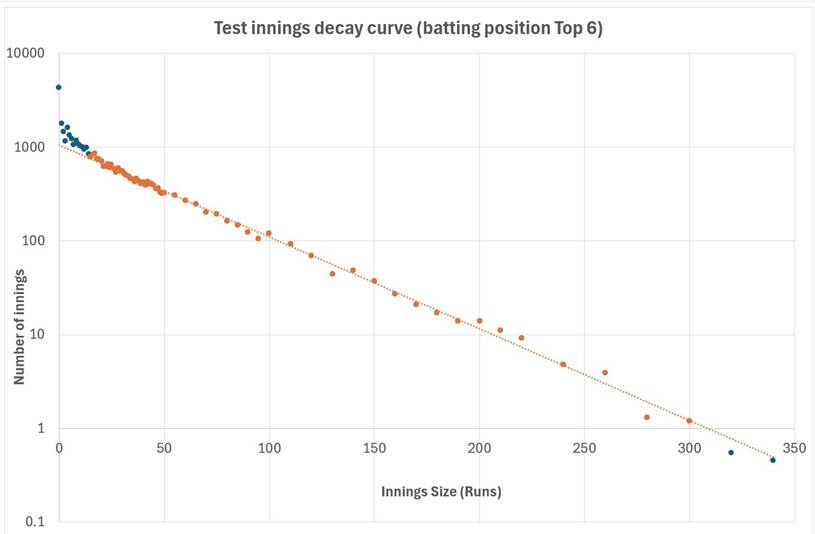
look at a ‘batting decay curve’, the number of innings by recognised batsmen
(those with median batting positions 1 to 6) at every level of scoring. I
have taken the liberty of including not outs by adding the batsman’s career
average to the score (this can be supported statistically, in a broad sense).
So an innings of 100 not out by a batsman who averages 50 registers as a
score equivalent to 150. Above a score of
50, I have pooled results to smooth the curve. So the point at 110 represents
the average of scores 106 to 115. The size of the pool is larger at very high
(and rarer) scores. Averaging out at the high end, across a wide pool, can
give values less than 1.
The graph is
log-linear because the results are exponential, with quite a good fit to a
simple exponential decay curve (the trendline is based on data from 15 to
300). Put simply, a batsman’s chances of getting out when he reaches a given
score is about 2.6 per cent, and this applies, in a broad sense, at all
scores from about 20 all the way to 300 or beyond. Naturally, individual
batsmen can and do deviate from this trend, but the averages are fairly
consistent. There are some
general deviations, though. That 2.6 per cent probability of getting out
doesn’t settle down until a score of about 15. In particular, There are more
than 4200 ducks which represent about 15 per cent of all innings. Between 50
and 100, the chances of getting out are slightly lower than the long-view
average, while from 200 to 250, the chances are a bit higher. ******** 400 runs in a
first-class match without a quadruple century
[Note: EDITED
the Perera instance was left out of the original table.] |
||||||||||||||||||||||||||||||||||||||||||||||||||||||||||||||||||||||||||||||||||||||||||||||||||||||||||||||||||||||||||||||||||||||||||||||||||||||||||||||||||||||||||||||||||||||||||||||||||||||||||||||||||||||||||||||||||||||||||||||||||||||||||||||||||||||||||||||||||||||||||||||||||||||||||||||||||||||||||||||||||||||||||||||||||||||||||||||||||||||||||||||||||||||||||||||||||||||||||||||||||||||||||||||||||||||||||||||||||||||||||||||||||||||||||||||||||||||||||||||||||||||||||||||||||||||
|
|
“Substitute” bowlers taking a wicket in same over
|
||||||||||||||||||||||||||||||||||||||||||||||||||||||||||||||||||||||||||||||||||||||||||||||||||||||||||||||||||||||||||||||||||||||||||||||||||||||||||||||||||||||||||||||||||||||||||||||||||||||||||||||||||||||||||||||||||||||||||||||||||||||||||||||||||||||||||||||||||||||||||||||||||||||||||||||||||||||||||||||||||||||||||||||||||||||||||||||||||||||||||||||||||||||||||||||||||||||||||||||||||||||||||||||||||||||||||||||||||||||||||||||||||||||||||||||||||||||||||||||||||||||||||||||||||||||
|
|
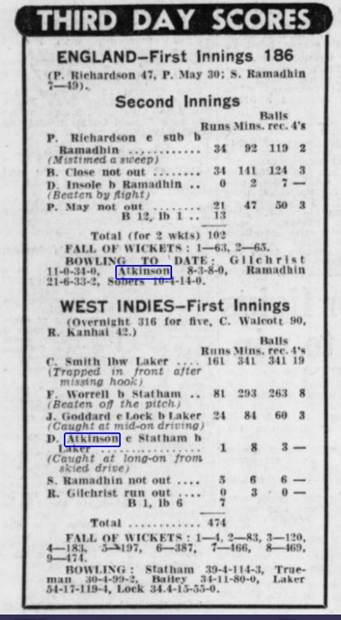
16 April 2025 More on 1957 I mentioned in February the discovery of some Balls Faced
figures for the 1957 England/West Indies series, found in the Daily
Express newspaper. Previously, I had calculated balls faced figures by
re-scoring surviving scorebooks. I have now tabulated these
and compared them to the Express figures (where available –
not all innings were covered) at the link. The comparison was disconcerting in places, in that
there were many differences between the two data sets. In my original
analysis, I had already flagged the fact that anomalies, even provable
errors, had cropped up in some of the scores. This was not uncommon in scores
from this era. Additional uncertainty was created because byes and leg byes
were not marked in the scores; I had to estimate their position in a way that
preserved the batsmen’s runs scored and sequence of scoring strokes. As a
result, balls faced for most large innings contained uncertainties. If Cowdrey faced 613 balls, then his century came
off 527 balls; I previously had 535. The 527 is still the slowest known Test
century of all time, although Nazar Mohammad
may have exceeded this at Lucknow in 1952-53 (no published figures for
Balls faced, but Nazar batted 174 overs to reach 100, to Cowdrey’s 166). An additional problem with this innings is the
difference in balls faced by the openers. The rescore gives Peter Richardson
100 balls but the Express says 119, a wide gap. Once again there are
identifiable errors in the score, so maybe we should accept the Express
numbers. But note that the 119 balls would require about 62 % of the strike
to Brian Close’s 38 %, possible but rather unusual for a 32-over partnership. ******** |
||||||||||||||||||||||||||||||||||||||||||||||||||||||||||||||||||||||||||||||||||||||||||||||||||||||||||||||||||||||||||||||||||||||||||||||||||||||||||||||||||||||||||||||||||||||||||||||||||||||||||||||||||||||||||||||||||||||||||||||||||||||||||||||||||||||||||||||||||||||||||||||||||||||||||||||||||||||||||||||||||||||||||||||||||||||||||||||||||||||||||||||||||||||||||||||||||||||||||||||||||||||||||||||||||||||||||||||||||||||||||||||||||||||||||||||||||||||||||||||||||||||||||||||||||||||
|
I have been
alerted to a problem with ball-by-ball files that were posted recently in the
online database, wherein the over-by-over bowler figures could be seriously
wrong with respect to runs conceded. Other columns did not exhibit any
problems, so the actual ball-by-ball data were correct apart from those runs
conceded. The problem cropped up especially in Tests from October 2010 to
November 2011. These have all been fixed now. ******** I was
watching the European Club championships, for a laugh. One team need 65 off
the last 17 balls and got them with a ball to spare. One batsman reached 47
off 10 balls but was out next ball trying to reach his 50. ******** At Bulawayo
in January, Sean Williams was given not out caught behind, but then walked
(there was no DRS in that Test). I wonder if there are any other examples in
recent times. I recall that Ravi Ashwin once walked when there was no appeal. ******** One thing
that has become clear in the DRS era is that batsmen frequently do not have a
clue whether they are out or not, and even if certain about being not out
they can be wrong. There are more than 120 cases of batsmen going to DRS
after being given out caught behind, when in fact they had hit the ball. Many
of them were probably hoping for some glitch in the DRS, but there must also
be many who were just kidding themselves that they hadn't hit the ball. Likewise
there must be cases of batsmen who think they hit the ball but didn't. Lara
may be one of them. Mitchell Marsh appeared to walk before the umpire's
decision, after missing the ball at Adelaide in December. |
4 April 2025 Back pain is
making life a bit of a misery at the moment; I am slowing down. Anyway, here
is some broader data on dropped catches over the last eight years on a team
basis, drawn from Cricinfo’s ball-by-ball texts. I won’t say much
about it; make of it what you will. There is a broad but slight improvement
trend in this century, but results for individuals years for particular
countries can vary a lot. I am a bit mystified by Pakistan’s good showing in
some years. My general impression has been that Pakistan is a weak catching
team, but they seem to have spells of very good results. I mentioned recently
that I could not find any dropped catches at all in a recent Test involving
Pakistan at Multan. That Test was in 2025 and is not included in the data
here.
Using the
Cricinfo bbb texts, I have analysed more than one thousand Tests for dropped
catches going back to 2001. (I started this process around 2008 but went back
and did some earlier Tests from 2001 on, and a few from 1999 and 2000). I
have also obtained drop catch data for almost 400 earlier Tests, the majority
involving Australia or England. The total represents drop catch data for
about 55 per cent of all Tests. ******** |
||||||||||||||||||||||||||||||||||||||||||||||||||||||||||||||||||||||||||||||||||||||||||||||||||||||||||||||||||||||||||||||||||||||||||||||||||||||||||||||||||||||||||||||||||||||||||||||||||||||||||||||||||||||||||||||||||||||||||||||||||||||||||||||||||||||||||||||||||||||||||||||||||||||||||||||||||||||||||||||||||||||||||||||||||||||||||||||||||||||||||||||||||||||||||||||||||||||||||||||||||||||||||||||||||||||||||||||||||||||||||||||||||||||||||||||||||||||||||||||||||||||||||||||||||||||
|
A small
adjustment; at Bridgetown in 1983, West Indies target of just one run was
reached with a no ball bowled by Kirmani. While Kirmani was (correctly)
recorded as bowling 0.1 overs, it can be confirmed that he bowled two
deliveries to Greenidge (source, Barbados Advocate) including the no ball from "a
run up longer than Michael Holding's". Greenidge did not hit either
delivery. https://www.sportstats.com.au/zArchive/1980s/1982WI/1982WI4.pdf ******** |
12 March 2025 Four Wickets in Five Balls: a Discovery Coming back from
an Antarctic cruise, I found that the ACS Journal has published a little
article of mine, on the discovery of a previously unknown case of four
wickets in five balls in a Test match, taken by Imran Khan in a Test match at
Sialkot in 1985. The discovery was made by my Pakistan contact Shahzad Khan,
hence he is listed as lead author. I have rendered
the score supplied by Shahzad into ball-by-ball form, as best as I was able.
Although the score, like many from the subcontinent in the 1980s, contained
anomalies and unexplained inconsistencies, the section containing Imran’s
feat was not in doubt. https://www.sportstats.com.au/zArchive/1980s/1985PL/1985PL2bbb1.pdf https://www.sportstats.com.au/zArchive/1980s/1985PL/1985PL2.pdf ******** |
||||||||||||||||||||||||||||||||||||||||||||||||||||||||||||||||||||||||||||||||||||||||||||||||||||||||||||||||||||||||||||||||||||||||||||||||||||||||||||||||||||||||||||||||||||||||||||||||||||||||||||||||||||||||||||||||||||||||||||||||||||||||||||||||||||||||||||||||||||||||||||||||||||||||||||||||||||||||||||||||||||||||||||||||||||||||||||||||||||||||||||||||||||||||||||||||||||||||||||||||||||||||||||||||||||||||||||||||||||||||||||||||||||||||||||||||||||||||||||||||||||||||||||||||||||||
|
The England
Women managed to drop seven catches in one day on the way to being clobbered
by an innings in the Test at the MCG. I can find only one men’s Test team
that can top that – Pakistan v England at Faisalabad on 22nd Nov
2005, dropping eight catches and taking only two on the third day of the
Test. ******** |
2 February 2025 Early Reports of Balls Faced in Tests
This was the first year of such detailed reporting
in the Express. In 1956, there was a column for minutes batted but not
Balls Faced. After 1957, the BF reporting continued up to 1961 for home
Tests. They gave up on it for the 1962 Tests, and it is a shame that it
didn’t catch on elsewhere. It has created a bit of a problem; the BF data found
so far is sometimes difficult to
reconcile fully with my own re-scoring of the traditional scoresheets
preserved from this series. I will have to study this more at some stage. The Daily Express has been a paper that has
mostly been out of reach in Australia in the past. The extended British
Newspaper Archive (subscription required) has been progressively adding more
years of this most useful paper to its online service. ******** Compiling some
more dropped catch reports, I found up to seven missed chances in a single
innings of 234 by Rahmat Shah of Afghanistan against Zimbabwe at Bulawayo
last month. This would be a modern-day record, comparable to the all-time
high set by Bonnor in 1883. However, some are ambiguous and opinions may vary
on which if any should be excluded. Here are the Cricinfo descriptions... 10.4^2&Nyamhuri to Rahmat, 2 runs,dropped by Myers at the
gully region! Short of a length ball
angling away with extra bounce, slices it straight to the gully fielder, tires to reverse cup it and goes through
the hands of Myers!,, 18.4^•&Muzarabani to Rahmat, no run,Back of a length ball on
the fifth stump line, punches off the
back foot, thick outside edge to the gully fielder, dives to his left-side and grassed it! Myers is the
fielder there, dropped his second
today, both chances were extremely difficult though.,, 28.5^4&Williams to Rahmat, FOUR runs,dropped again!
Quicker length ball cuts it square and
thick outside edge past the first slip fielder, similar to the one
Ervine dropped earlier, shoulder
height and slow reaction from the fielder,,
37.2^3&Williams to Rahmat, 3 runs,chance! Full ball just
outside off. Turning away and Rahmat
attempts a drive. Takes the outside edge and goes past the diving
first slip fielder. Down to deep
third for three runs with Mavuta's slide stopping the boundary,, 79.6^1&Williams to Rahmat, 1 run,dropped! Last ball before
the second new ball gets available!
Full ball on middle, Rahmat comes down the track, lifts it down the V, and Nyamhuri at long-on has
misjudged it! He runs in, then tries to
backtrack, and all he can get is a fingertip! Williams looks
disappointed and Shahidi
survives,, 92.5^•&Muzarabani to Rahmat, no run,Muzarabani dropped a
sitter! Back of a length ball on the
leg stump, plays the leg glance shot early and finds the leading edge,
hits it straight back to the bowler,
easy pickings for the bowler and Muzarabani
fumbles it!,, 116.4^•&Williams to Rahmat, no run,Another dropped catch?
Back of a length ball turning away on
the off stump, plays the square cut late, extra bounce and might have outside edged back to the keeper, Gumbie
failed to grab the ball. The reaction
from Ervine at the first slip position explains everything.,, AND here are the Cricbuzz descriptions.
There are certainly some differences... 10.4 Newman Nyamhuri to Rahmat, 2 runs,
dropped! Back of a length outside off,
Rahmat cuts and doesn't bother to keep it down. Goes quickly to gully
and Dion Myers fails to hold onto it.
Tries to reverse-cup and the ball bursts
through his palms 18.4 Muzarabani to Rahmat, no run, back of
length and wide, Rahmat pushes at it
away from the body and the ball takes a thick edge. Dies down onto the
gully fielder who was leaping
forward. Just short 28.5 Williams to Rahmat, FOUR, dropped! short
on length onto off, Rahmat tries to
cut and gets an edge that flies to the left of first slip. Whizzes past him before he could react and runs away
for four 37.2 Williams to Rahmat, 3 runs, slower
through the air, Rahmat goes for the
drive and the outside edge beats a diving Ervine to his right at first
slip 79.6 Williams to Rahmat, 1 run, dropped! A
miscued lofted drive from Rahmat
after he shimmies down the track. Nyamhuri backpedals from deep-ish
mid-on and fails to hold onto it as
he tries to catch it overhead. Another reprieve for Rahmat! Williams won't be happy with
that 92.5 Muzarabani to Rahmat, no run, dropped!
Back of length and gets some extra
bounce onto off stump, Rahmat tried to clip it leg side but gets a
leading edge that lobs back to the bowler.
A simple return catch put down by the
bowler. Rahmat Shah gets two lives in this over! 116.4 Williams to Rahmat, no run, short and
extra bounce outside off, goes over
the attempted cut I concluded that
the 37.2 “3 runs,chance!” incident was not really a dropped catch. (Some
reporters don’t use ‘chance’ to mean a
dropped catch.) That leaves us with six dropped catches in Rahmat’s innings. A couple of
little extras on dropped catches... -
When Harry Brook scored 171 at Christchurch, he was missed five times.
This equals an England 'record' (again, very much a 'where known' record) of
WG Grace (170) in 1886. As often happens, there is some ambiguity about
Brooks' tally: one of the misses was called leg bye by the umpire, but was
clearly off the bat on replay. If the keeper had made the catch, a review
would have overturned the leg bye call, so it should stand as a dropped
catch. -
I could not find a single dropped catch in the first Test between West
Indies and Pakistan at Multan a few weeks ago. A contact of mine who also
follows these things (Garry Morgan) concurs. In the last 20-odd years I think
that there are only a couple of other completed Tests where I could not find
any misses. I have updated a
list of the most fumble-favoured innings in Tests. Naturally, there could be
others yet to be recognised… Batsmen dropped
most times in a Test innings (where known)
UPDATE: Trevor
Bailey was reportedly dropped five times in making 82 against West Indies at
Lord’s in 1957. ******** |
||||||||||||||||||||||||||||||||||||||||||||||||||||||||||||||||||||||||||||||||||||||||||||||||||||||||||||||||||||||||||||||||||||||||||||||||||||||||||||||||||||||||||||||||||||||||||||||||||||||||||||||||||||||||||||||||||||||||||||||||||||||||||||||||||||||||||||||||||||||||||||||||||||||||||||||||||||||||||||||||||||||||||||||||||||||||||||||||||||||||||||||||||||||||||||||||||||||||||||||||||||||||||||||||||||||||||||||||||||||||||||||||||||||||||||||||||||||||||||||||||||||||||||||||||||||
|
At the start
of the Border-Gavaskar Trophy series, Virat Kohli needed 49 runs of Nathan
Lyon's bowling to set a new head-to-head record. However, he
managed only 44 runs off Lyon in 5 Tests, taking him to 573 runs, short of
the 577 by Steve Smith off Broad. Kohli did manage to top Pujara's take off
Lyon of 571 runs. Most would
have backed Kohli to take this record, but a combination of Kohli's
indifferent form, and Lyon hardly being given a proper bowl, denied him. It is
conceivable that they will play one another again. ******** A few little
notes from a day at the cricket... There was a
'double overthrow', although only 3 runs were scored. I know Allan Knott once
got a seven this way, but does anyone know of other instances? There were no
advertising logos painted on the (hallowed) turf, just one word
"Melbourne" at the east end. I wonder if this was a change of
policy, or not enough sponsorship. I saw Mike
Walsh's name as one of the official scorers. Mike first scored a Test match
at the MCG in 1980-81. Eden Gardens’
record for biggest whole-Test crowd still stands, although this match was the
biggest accurately-counted match. ******** As far as
long-serving scorers go, Dr Murray Power has been scoring for Ireland since
1976, although full Test matches only started for Ireland much more recently. Apparently
the MCG Test was Mike Walsh’s 101st Test as scorer. Amazingly he
is only halfway to Bill Ferguson’s tally. I saw an inaccurate number given
online for Fergie and took a closer look. Fergie himself claimed that he
scored 204 Tests. However, this includes the final test of 1930-31, whereas the
surviving score for this Test includes a note that Fergie was ill and there
was a stand-in scorer. ******** In the
1982-83 Ashes, Ian Botham either batted or bowled on all 25 days of the
five-Test series. Wally Hammond
batted or bowled on 30 days of the 1928-29 series, but there were 33 days
play in that series (Timeless Tests). There were
only 21 days in the 2009 Ashes, but Stuart Broad batted or bowled on all of
them. Also on 21, VS Hazare in Aus in 1947-48, KR Miller in 1950-51 Ashes,
and NAT Adcock SA v Eng 1960. Haven't
checked these numbers thoroughly. Data is from bbb files only. ******** |
13 January 2025 Sobers – Separating his Bowling Styles I have been
asked a few times over the years about Garry Sobers’ variety of bowling
styles and what contribution each style made to his statistics – has anyone
compiled any data on this question? I haven’t seen any, so I took a little
time and did some research on this. Unfortunately
the surviving scorebooks provide almost no relevant information, with no
specification of bowling styles at different times. So I turned to detailed
newspaper reports and/or film highlights where available – ten series in all.
The selected series extended from 1959-60 to 1973, covering 44 Tests in all,
more than half of Sobers’ Tests in this period. In a few of the
Tests, Sobers took no wickets. In the Tests where he took wickets, I was able
to distinguish between pace and spin for all his wickets, almost 150 of his
235 career wickets. Results look like so… Garfield Sobers – Wickets by Bowling
Type (Selected Series)
(Unfortunately,
in most cases I wasn’t always able to glean enough info to distinguish
between Sobers’ finger-spin and wrist-spin styles. Sobers said in his
autobiography that he stopped bowling wrist spin after 1966 due to shoulder
problems.) While this is
not necessarily a random sampling of Sobers’ Tests in this period, it is
quite a large sample. There were about
15 Tests out of the 44 in which he took wickets with both pace and spin
within the same match. There is
definitely a historical pattern. While I didn’t do detailed research prior to
1960, what I did see suggested that all Sobers’ early wickets were taken with
spin bowling – finger-spin I think (although some reports talk of him bowling
“leg breaks” which I take to mean left arm orthodox). Sobers had been
selected initially as a spin bowler, but within a few years he was setting
world records as a batsman, while his bowling efforts were moderate at best.
In 1960-61, he introduced his pace bowling style, probably because the team
touring Australia was already stronger in spin than pace. In 1961-62 at home,
wickets were more spin friendly and he took most of his wickets accordingly.
For a number of years, he mixed his bowling styles with considerable success. In later Tests,
after 1968-69 in Australia, the table shows that Sobers bowled less and less
spin. This was also evident in detailed film highlights of the World XI
matches in 1971-72, where all the bowling that I could see was pace bowling. Here is a second
table summarising all of Sobers’ Test wickets. Some estimates are necessary
but I think the final result would be reasonably robust.
I would stress
that I have no information on the number of overs or runs conceded using the
different styles in the above tables. Note that Sobers’ bowling average in
his spin-only stage up to 1960 was a rather indifferent 45.0 (32 Tests, 40
wickets). His bowling average in his later pace-only Tests from 1969 was 30.9
(20 Tests, 53 wickets). I note that some
reporters describe his pace bowling as “medium pace” and others say
“fast-medium”. I don’t know if the distinctions are meaningful; others may
know more about this. ********* Sam Konstas, in
the MCG Test against India, scored his first 50 runs in Test cricket just 66
minutes into his first Test match, facing 52 balls. Probably the fastest for
any player: PP Shaw took about 75 minutes for India in 2018, although that
time is only an estimate. Shaw scored 75 before lunch, the most (in a
strictly 2-hour session) by any debutant on the first day. LJ Tancred scored
87 before lunch on debut in 1902, in a slightly extended session. Konstas’s
60 runs was also just shy of Rick Darling’s 61 before lunch on debut in 1978. ******** Fewest Balls
Faced for an Innings over 60, All Tests
Complete innings
only. Others have reached 60 in fewer balls, but they continued batting. ******** |
||||||||||||||||||||||||||||||||||||||||||||||||||||||||||||||||||||||||||||||||||||||||||||||||||||||||||||||||||||||||||||||||||||||||||||||||||||||||||||||||||||||||||||||||||||||||||||||||||||||||||||||||||||||||||||||||||||||||||||||||||||||||||||||||||||||||||||||||||||||||||||||||||||||||||||||||||||||||||||||||||||||||||||||||||||||||||||||||||||||||||||||||||||||||||||||||||||||||||||||||||||||||||||||||||||||||||||||||||||||||||||||||||||||||||||||||||||||||||||||||||||||||||||||||||||||
|
|
|
||||||||||||||||||||||||||||||||||||||||||||||||||||||||||||||||||||||||||||||||||||||||||||||||||||||||||||||||||||||||||||||||||||||||||||||||||||||||||||||||||||||||||||||||||||||||||||||||||||||||||||||||||||||||||||||||||||||||||||||||||||||||||||||||||||||||||||||||||||||||||||||||||||||||||||||||||||||||||||||||||||||||||||||||||||||||||||||||||||||||||||||||||||||||||||||||||||||||||||||||||||||||||||||||||||||||||||||||||||||||||||||||||||||||||||||||||||||||||||||||||||||||||||||||||||||
|
|
|
||||||||||||||||||||||||||||||||||||||||||||||||||||||||||||||||||||||||||||||||||||||||||||||||||||||||||||||||||||||||||||||||||||||||||||||||||||||||||||||||||||||||||||||||||||||||||||||||||||||||||||||||||||||||||||||||||||||||||||||||||||||||||||||||||||||||||||||||||||||||||||||||||||||||||||||||||||||||||||||||||||||||||||||||||||||||||||||||||||||||||||||||||||||||||||||||||||||||||||||||||||||||||||||||||||||||||||||||||||||||||||||||||||||||||||||||||||||||||||||||||||||||||||||||||||||
|
|
|
||||||||||||||||||||||||||||||||||||||||||||||||||||||||||||||||||||||||||||||||||||||||||||||||||||||||||||||||||||||||||||||||||||||||||||||||||||||||||||||||||||||||||||||||||||||||||||||||||||||||||||||||||||||||||||||||||||||||||||||||||||||||||||||||||||||||||||||||||||||||||||||||||||||||||||||||||||||||||||||||||||||||||||||||||||||||||||||||||||||||||||||||||||||||||||||||||||||||||||||||||||||||||||||||||||||||||||||||||||||||||||||||||||||||||||||||||||||||||||||||||||||||||||||||||||||
|
|
|
||||||||||||||||||||||||||||||||||||||||||||||||||||||||||||||||||||||||||||||||||||||||||||||||||||||||||||||||||||||||||||||||||||||||||||||||||||||||||||||||||||||||||||||||||||||||||||||||||||||||||||||||||||||||||||||||||||||||||||||||||||||||||||||||||||||||||||||||||||||||||||||||||||||||||||||||||||||||||||||||||||||||||||||||||||||||||||||||||||||||||||||||||||||||||||||||||||||||||||||||||||||||||||||||||||||||||||||||||||||||||||||||||||||||||||||||||||||||||||||||||||||||||||||||||||||
|
|
|
||||||||||||||||||||||||||||||||||||||||||||||||||||||||||||||||||||||||||||||||||||||||||||||||||||||||||||||||||||||||||||||||||||||||||||||||||||||||||||||||||||||||||||||||||||||||||||||||||||||||||||||||||||||||||||||||||||||||||||||||||||||||||||||||||||||||||||||||||||||||||||||||||||||||||||||||||||||||||||||||||||||||||||||||||||||||||||||||||||||||||||||||||||||||||||||||||||||||||||||||||||||||||||||||||||||||||||||||||||||||||||||||||||||||||||||||||||||||||||||||||||||||||||||||||||||
|
|
|
||||||||||||||||||||||||||||||||||||||||||||||||||||||||||||||||||||||||||||||||||||||||||||||||||||||||||||||||||||||||||||||||||||||||||||||||||||||||||||||||||||||||||||||||||||||||||||||||||||||||||||||||||||||||||||||||||||||||||||||||||||||||||||||||||||||||||||||||||||||||||||||||||||||||||||||||||||||||||||||||||||||||||||||||||||||||||||||||||||||||||||||||||||||||||||||||||||||||||||||||||||||||||||||||||||||||||||||||||||||||||||||||||||||||||||||||||||||||||||||||||||||||||||||||||||||
|
|
|
||||||||||||||||||||||||||||||||||||||||||||||||||||||||||||||||||||||||||||||||||||||||||||||||||||||||||||||||||||||||||||||||||||||||||||||||||||||||||||||||||||||||||||||||||||||||||||||||||||||||||||||||||||||||||||||||||||||||||||||||||||||||||||||||||||||||||||||||||||||||||||||||||||||||||||||||||||||||||||||||||||||||||||||||||||||||||||||||||||||||||||||||||||||||||||||||||||||||||||||||||||||||||||||||||||||||||||||||||||||||||||||||||||||||||||||||||||||||||||||||||||||||||||||||||||||
|
|
|
||||||||||||||||||||||||||||||||||||||||||||||||||||||||||||||||||||||||||||||||||||||||||||||||||||||||||||||||||||||||||||||||||||||||||||||||||||||||||||||||||||||||||||||||||||||||||||||||||||||||||||||||||||||||||||||||||||||||||||||||||||||||||||||||||||||||||||||||||||||||||||||||||||||||||||||||||||||||||||||||||||||||||||||||||||||||||||||||||||||||||||||||||||||||||||||||||||||||||||||||||||||||||||||||||||||||||||||||||||||||||||||||||||||||||||||||||||||||||||||||||||||||||||||||||||||
|
|
|
||||||||||||||||||||||||||||||||||||||||||||||||||||||||||||||||||||||||||||||||||||||||||||||||||||||||||||||||||||||||||||||||||||||||||||||||||||||||||||||||||||||||||||||||||||||||||||||||||||||||||||||||||||||||||||||||||||||||||||||||||||||||||||||||||||||||||||||||||||||||||||||||||||||||||||||||||||||||||||||||||||||||||||||||||||||||||||||||||||||||||||||||||||||||||||||||||||||||||||||||||||||||||||||||||||||||||||||||||||||||||||||||||||||||||||||||||||||||||||||||||||||||||||||||||||||
|
|
|
||||||||||||||||||||||||||||||||||||||||||||||||||||||||||||||||||||||||||||||||||||||||||||||||||||||||||||||||||||||||||||||||||||||||||||||||||||||||||||||||||||||||||||||||||||||||||||||||||||||||||||||||||||||||||||||||||||||||||||||||||||||||||||||||||||||||||||||||||||||||||||||||||||||||||||||||||||||||||||||||||||||||||||||||||||||||||||||||||||||||||||||||||||||||||||||||||||||||||||||||||||||||||||||||||||||||||||||||||||||||||||||||||||||||||||||||||||||||||||||||||||||||||||||||||||||
|
|
|
||||||||||||||||||||||||||||||||||||||||||||||||||||||||||||||||||||||||||||||||||||||||||||||||||||||||||||||||||||||||||||||||||||||||||||||||||||||||||||||||||||||||||||||||||||||||||||||||||||||||||||||||||||||||||||||||||||||||||||||||||||||||||||||||||||||||||||||||||||||||||||||||||||||||||||||||||||||||||||||||||||||||||||||||||||||||||||||||||||||||||||||||||||||||||||||||||||||||||||||||||||||||||||||||||||||||||||||||||||||||||||||||||||||||||||||||||||||||||||||||||||||||||||||||||||||
|
|
|
||||||||||||||||||||||||||||||||||||||||||||||||||||||||||||||||||||||||||||||||||||||||||||||||||||||||||||||||||||||||||||||||||||||||||||||||||||||||||||||||||||||||||||||||||||||||||||||||||||||||||||||||||||||||||||||||||||||||||||||||||||||||||||||||||||||||||||||||||||||||||||||||||||||||||||||||||||||||||||||||||||||||||||||||||||||||||||||||||||||||||||||||||||||||||||||||||||||||||||||||||||||||||||||||||||||||||||||||||||||||||||||||||||||||||||||||||||||||||||||||||||||||||||||||||||||
|
|
|
||||||||||||||||||||||||||||||||||||||||||||||||||||||||||||||||||||||||||||||||||||||||||||||||||||||||||||||||||||||||||||||||||||||||||||||||||||||||||||||||||||||||||||||||||||||||||||||||||||||||||||||||||||||||||||||||||||||||||||||||||||||||||||||||||||||||||||||||||||||||||||||||||||||||||||||||||||||||||||||||||||||||||||||||||||||||||||||||||||||||||||||||||||||||||||||||||||||||||||||||||||||||||||||||||||||||||||||||||||||||||||||||||||||||||||||||||||||||||||||||||||||||||||||||||||||
|
|
|
||||||||||||||||||||||||||||||||||||||||||||||||||||||||||||||||||||||||||||||||||||||||||||||||||||||||||||||||||||||||||||||||||||||||||||||||||||||||||||||||||||||||||||||||||||||||||||||||||||||||||||||||||||||||||||||||||||||||||||||||||||||||||||||||||||||||||||||||||||||||||||||||||||||||||||||||||||||||||||||||||||||||||||||||||||||||||||||||||||||||||||||||||||||||||||||||||||||||||||||||||||||||||||||||||||||||||||||||||||||||||||||||||||||||||||||||||||||||||||||||||||||||||||||||||||||
|
|
|
||||||||||||||||||||||||||||||||||||||||||||||||||||||||||||||||||||||||||||||||||||||||||||||||||||||||||||||||||||||||||||||||||||||||||||||||||||||||||||||||||||||||||||||||||||||||||||||||||||||||||||||||||||||||||||||||||||||||||||||||||||||||||||||||||||||||||||||||||||||||||||||||||||||||||||||||||||||||||||||||||||||||||||||||||||||||||||||||||||||||||||||||||||||||||||||||||||||||||||||||||||||||||||||||||||||||||||||||||||||||||||||||||||||||||||||||||||||||||||||||||||||||||||||||||||||
|
|
|
||||||||||||||||||||||||||||||||||||||||||||||||||||||||||||||||||||||||||||||||||||||||||||||||||||||||||||||||||||||||||||||||||||||||||||||||||||||||||||||||||||||||||||||||||||||||||||||||||||||||||||||||||||||||||||||||||||||||||||||||||||||||||||||||||||||||||||||||||||||||||||||||||||||||||||||||||||||||||||||||||||||||||||||||||||||||||||||||||||||||||||||||||||||||||||||||||||||||||||||||||||||||||||||||||||||||||||||||||||||||||||||||||||||||||||||||||||||||||||||||||||||||||||||||||||||